Automation Platform
NODEBASE
ROLE
SOLO BUILD — FULL STACK
TIMELINE
SHIPPED · ACTIVELY MAINTAINED
SCOPE
STACK
OVERVIEW
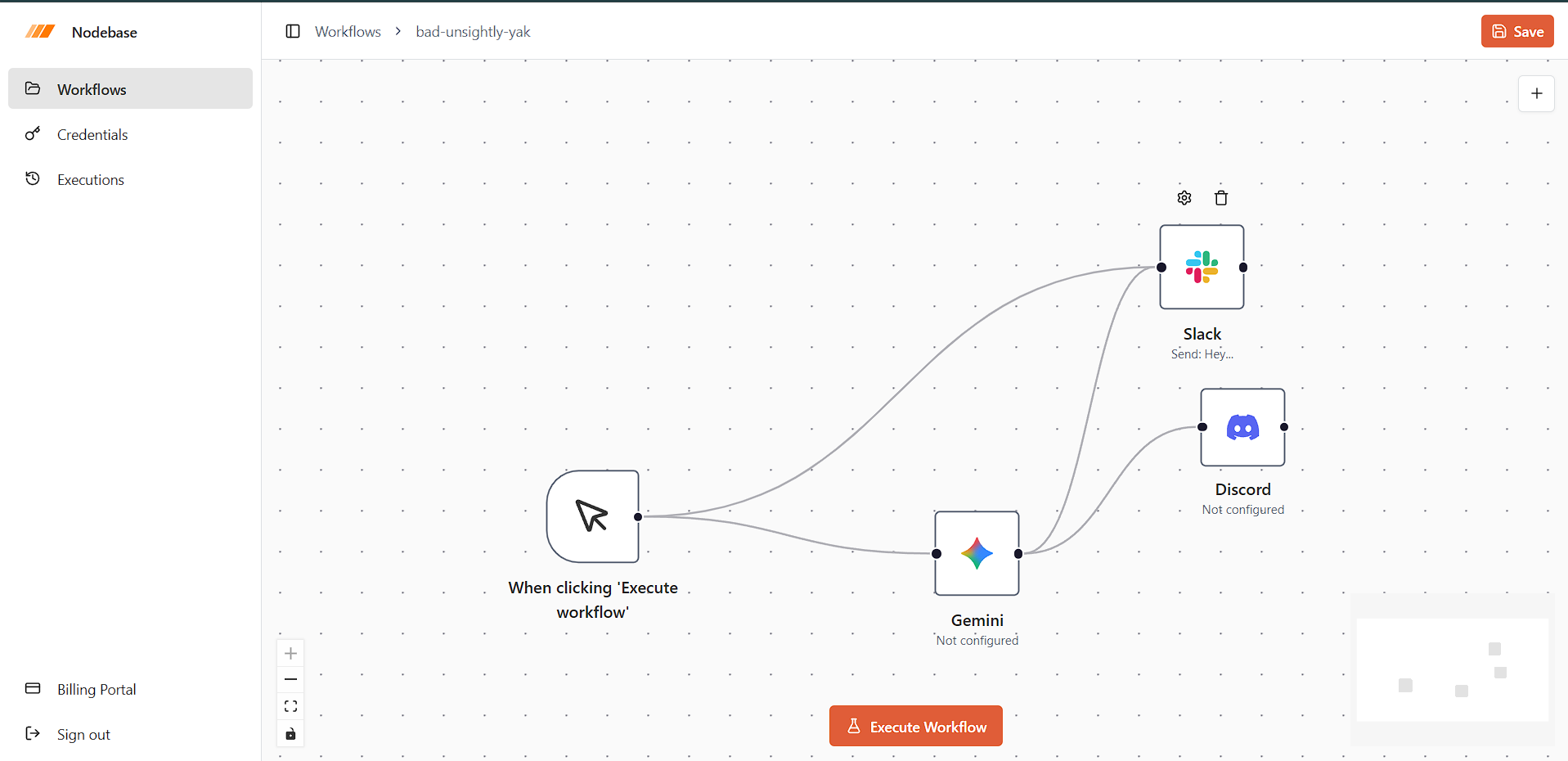
Design automation pipelines on a React Flow canvas — Stripe and Google Forms triggers, GPT/Claude/Gemini processors, Discord and Slack outputs — and watch every node light up live as Inngest executes the run.
Nodebase's editor composes workflows from ten node types: manual and webhook triggers (Stripe, Google Forms), HTTP actions, three AI processors (OpenAI GPT-4, Anthropic Claude, Google Gemini), and messaging outputs to Discord and Slack. Execution streams node state transitions — loading, success, error — back to the canvas in real time over Inngest Realtime.
The API layer is sixteen tRPC procedures with Zod validation for end-to-end type safety, backed by Prisma on Neon Postgres across nine data models. API credentials are AES-encrypted at rest and decrypted only at runtime; auth supports email plus GitHub and Google OAuth via Better Auth, with premium features gated through Polar.sh subscriptions.
The repo runs like a product: 15 documentation files including architecture diagrams and ADRs, OWASP-mapped security notes, Sentry monitoring, Biome linting, and semantic-release CI that has cut eighteen tagged versions.
OUTCOMES
Reliable, observable, secure automation — without owning a single server.